

Why People Are Moving to Counties in Florida
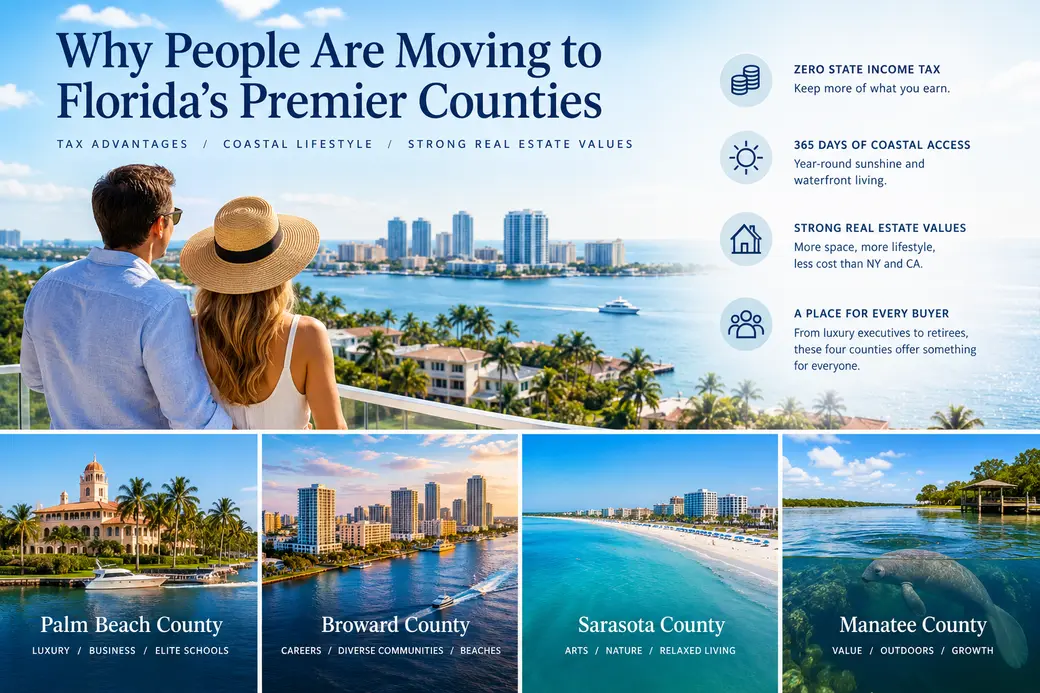
People are moving to Palm Beach, Broward, Sarasota, and Manatee counties because Florida's zero state income tax, 365 days of coastal access, and real estate values that still undercut comparable markets in New York and California add up to a financial and lifestyle case that's genuinely hard to argue against. Each county pulls a different buyer, luxury finance executives, Northeast families, Gulf Coast retirees, and value-driven first movers, but the structural advantages underneath are the same across all four. If you're weighing a Florida relocation, these four counties are the ones that belong at the center of that conversation.
Florida's Migration Has Cooled, but These Counties Are Still Leading It
Florida added 196,680 residents between July 2024 and July 2025, well under half of the 467,347-person gain the state posted the year before, a second-largest numeric increase in the country, according to U.S. Census Bureau Vintage 2025 Population Estimates, released January 2026. Texas ranked first with 391,243 new residents; Florida ranked second, though it no longer cracks the top five states by percentage growth, a list now led by South Carolina, Idaho, North Carolina, Texas, and Utah.
The largest outbound states sending residents to Florida are consistently New York, California, and Illinois, high-tax, high-cost states where the contrast with Florida's zero income tax is felt most sharply. That said, the domestic side of this story has cooled substantially: Florida's net domestic migration fell to 22,517 in the year ending July 2025, down from 183,646 in 2023 and 310,892 in 2022, and the state ranked just 8th nationally for net domestic migration, trailing Alabama, according to the same Vintage 2025 estimates. The slowdown is most pronounced in the largest, most expensive urban cores. Mid-sized coastal counties, including Sarasota and Manatee, have continued to attract inflows even as the statewide trend has softened, and Palm Beach County's business-driven migration remains a comparative bright spot. The Bureau of Economic and Business Research (BEBR) at the University of Florida, Manatee County leads the entire Tampa Bay region in projected percentage growth through 2030 at 10.34%, the highest of any county in that corridor.
United Van Lines' 2025 National Movers Study found that the top three reasons Americans are moving interstate are wanting to be closer to family (29%), a new job or company transfer (26%), and retirement (14%). For Florida-bound movers specifically, no state income tax amplifies the financial case behind all three motivations.
The Tax Advantage Behind Florida's Migration
Florida is one of only nine states with no personal income tax, and for higher earners, the advantage is substantial. Key exemptions include:
-
No state income tax, someone relocating from New York or California, where top marginal rates exceed 10%, can meaningfully reorder their financial picture simply by establishing Florida residency
-
Retirement income, Social Security, pension distributions, and IRA withdrawals are all exempt from state taxation
-
No state estate tax, a factor that regularly enters planning conversations for high-net-worth families considering generational wealth strategy
That structural advantage underpins nearly every other reason people are moving to these four counties. It makes even premium real estate feel less expensive than it looks on paper, and it makes the comparison to high-tax states increasingly difficult to dismiss.
Why People Are Moving to Palm Beach County: Luxury, Business, and Elite Schools
Palm Beach County's population reached approximately 1.58 million in 2025, making it the third-largest county in Florida, according to U.S. Census Bureau data. What was once primarily a retirement enclave has become a genuine center for institutional finance, tech, and professional services. Dozens of hedge funds, private equity groups, and asset managers have established a presence around the Downtown West Palm Beach corridor, and the county's average annual salary is the highest in Florida.
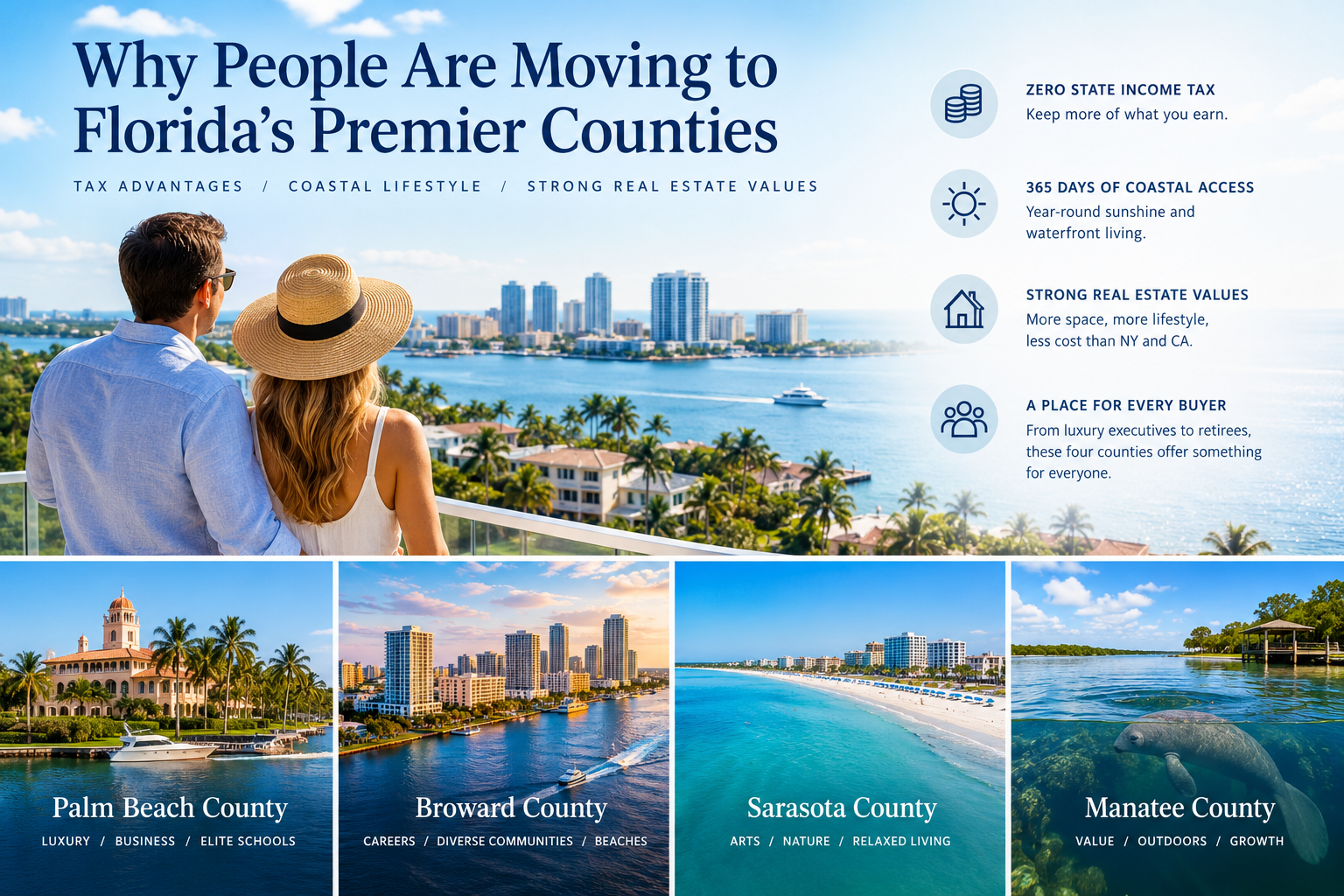
The single-family market reflects that strength. According to Miami Realtors, Palm Beach County total home sales climbed for seven consecutive months through March 2026, with the single-family median sale price up 3.2% year-over-year to $645,000. In the luxury segment, a substantial share of March 2026 single-family closings were priced at $1 million or above, and the ultra-luxury $10M+ tier saw markedly stronger activity than the prior year, according to Miami Realtors Palm Beach County market data.
Three distinct zones shape the Palm Beach buying experience:
-
South Palm Beach County, Boca Raton, Delray Beach, and Boynton Beach offer polished infrastructure, top-rated public schools, and walkable downtowns. This is where families from the Northeast often land when they want structure and amenity without Miami-Dade's density.
-
Central Palm Beach County, West Palm Beach's urban core, Wellington's acreage communities, and the storied enclave of Palm Beach Island cater to buyers who want either downtown energy or wide-open space, two very different markets within the same county. Mid-range buyers find strong value in Wellington and the surrounding communities, where single-family homes broadly fall in the $500,000–$850,000 range. Entry-level options in western suburbs such as Royal Palm Beach and Loxahatchee typically range from $400,000 to $580,000, the county's most accessible price tier and the most common landing point for families relocating from the Northeast.
-
North Palm Beach County, Jupiter, Palm Beach Gardens, and Tequesta draw the beach-town lifestyle crowd: boaters, golfers, and buyers who want a relaxed pace without sacrificing access to quality services.
Palm Beach County's 66 A-rated elementary schools also represent one of the strongest public education networks in South Florida, a factor that consistently tips fence-sitting buyers toward commitment.
For a look at what's currently available across the county's price spectrum, Palm Beach County homes for sale span from luxury estates on Palm Beach Island to mid-range family homes in the western suburbs.
Why People Are Moving to Broward County: Urban Amenities at Three Price Tiers
Broward County, home to Fort Lauderdale, Hollywood, Pembroke Pines, and Coral Springs, occupies the middle chapter in South Florida's migration story. With a population of approximately 2.0 million, it offers a denser, more urban experience than Palm Beach County but delivers accessible pricing across entry, mid, and luxury levels.
The Broward single-family median sale price registered around $620,000 heading into 2026, according to aggregated MLS closed-sale data (Broward County single-family, Q4 2025). The luxury waterfront segment operates on its own timeline: deepwater-access single-family homes in Fort Lauderdale have commanded median prices well above $2 million in recent reporting periods, based on aggregated MLS data for ocean-access properties (six months ending Q4 2025). Fort Lauderdale's canal system, more than 300 miles of navigable waterways, continues to justify premium pricing for deepwater dockage, attracting luxury buyers from across the country and internationally.
The mid-range market is strongest in established neighborhoods from Weston to Coral Springs, where buyers find well-built single-family homes broadly in the $550,000–$850,000 range.
The affordable tier is most visible in West Broward's suburbs, Miramar, Pembroke Pines, and parts of Coral Springs, where entry-level single-family options remain broadly in the $390,000–$549,000 range, representing the most accessible price point in South Florida for buyers who want beach proximity without a barrier-island premium.
According to Miami Realtors, buyers from more than 70 countries have participated in South Florida real estate, a volume that sustains demand across every price tier in Broward's market. For people moving within South Florida, particularly from Miami-Dade, Broward's appeal is straightforward: comparable urban amenities and beach access at a lower entry point.
Buyers exploring the Broward market can get a sense of current inventory through Broward County homes for sale.
Why People Are Moving to Sarasota County: Gulf Coast Culture at Every Price Tier
Sarasota has appeared on nearly every major "best places to move" list in recent years, and the numbers support it. The Realtor Association of Sarasota and Manatee (RASM) reported a single-family median sale price of $492,450 for June 2026, up 8.2% year-over-year, with sales volume jumping 15.2% month-over-month, a market tightening after the post-pandemic correction.
The buyer pool has broadened considerably. Pre-pandemic Sarasota attracted mostly retirees and snowbirds. By 2026, the mix includes remote workers, entrepreneurs, families, and international buyers alongside the original retiree base.
Three price tiers define the Sarasota opportunity:
-
Luxury buyers gravitate toward barrier islands, Siesta Key, Casey Key, and Longboat Key, where waterfront estates and Gulf-view condos regularly exceed $2 million. Siesta Key's white-quartz sand is consistently rated among the finest beaches in the country, and that distinction supports premium pricing at the upper end.
-
Mid-range buyers find exceptional value in Palmer Ranch, the Sarasota city core, and newer master-planned communities inland, where the walkable downtown arts district, Selby Botanical Gardens, and a nationally recognized performing arts scene add lifestyle depth at a reasonable price, broadly in the $490,000–$850,000 range.
-
Affordable-tier buyers, particularly younger families and relocating professionals, are discovering North Sarasota and areas bordering Manatee County, where single-family homes fall broadly in the $330,000–$490,000 range, a price point that remains out of reach for comparable properties in Palm Beach or Broward.
An overview of Sarasota County homes and Gulf Coast properties can help buyers calibrate what each price tier looks like on the ground.
Why People Are Moving to Manatee County: The Growth Story That's Just Getting Started
Manatee County is still in its expansion phase, and that creates real pricing opportunity before the market fully catches up to its neighbors.
Manatee County's population grew from approximately 399,000 in 2020 to an estimated 468,000 in 2025, a 17% increase in five years, according to U.S. Census Bureau QuickFacts (V2025). More notably, BEBR projects Manatee County to add approximately 48,255 additional residents between 2025 and 2030, a 10.34% growth rate that leads the entire Tampa Bay region and ranks among the highest-growth counties in Florida through 2030.
The demographic arriving is well-resourced. New Yorkers led inbound driver's license transfers into Manatee County in 2025, and that group typically arrives with equity from high-cost markets, pricing expectations calibrated to New York metro costs, and a preference for waterfront or near-water living, which Anna Maria Island, Holmes Beach, and Lakewood Ranch deliver at a price point that often undercuts comparable Sarasota addresses.
RASM reported a Manatee County single-family median sale price of $490,000 for June 2026, up 11.4% year-over-year, with closed sales jumping 26.2% in the same period, the strongest year-over-year volume gain of any segment that month.
For affordable and mid-range buyers, Manatee County is one of the most practical landing spots in this corridor. The condo and townhouse market remains buyer-favorable with meaningful inventory, particularly useful for relocators who want to rent or hold a seasonal property before committing to a primary purchase.
Lakewood Ranch, straddling the Sarasota-Manatee county line, deserves specific mention. It has ranked among the top-selling master-planned communities in the United States for multiple consecutive years, driven by a mix of entry-level, mid-range, and luxury villages with resort-style amenities, A-rated schools, and a town center environment that appeals to families and active adults alike.
Manatee County homes and Lakewood Ranch properties offer a useful starting point for understanding the range of options across the county's fast-growing sub-markets.
Luxury, Mid-Range, and Affordable: Which County Fits Your Budget?
| Price Tier | Best-Fit County / Area | General Range | Typical Buyer Profile |
|---|---|---|---|
| Luxury | Palm Beach Island, Boca Raton, Fort Lauderdale waterfront, Sarasota barrier islands | $1M+ single-family; $2M+ waterfront | Finance exec, international buyer, high-net-worth retiree |
| Mid-Range | Broward (Weston / Coral Springs), Sarasota city / Palmer Ranch, Lakewood Ranch | $500K–$900K | Northeast family relocator, remote professional |
| Affordable | West Broward suburbs, North Sarasota, Manatee County | $330K–$580K | First-time buyer, young family, value-focused relocator |
Price tiers reflect general market positioning based on aggregated MLS closed-sale data (twelve months ending June 2026) and are intended as directional context, not precise valuations. Individual neighborhoods and property types vary significantly within each county.
What to Expect When You Arrive
Every county in this corridor shares the same baseline advantages, no state income tax, year-round sunshine, Gulf or Atlantic beach access, and a robust restaurant and cultural scene. But the day-to-day texture differs across three practical dimensions.
Insurance Costs
Florida has the most expensive homeowner's insurance in the nation. Insurify's 2026 Insuring the American Homeowner Report, the average Florida homeowner paid approximately $8,292 annually in 2025, nearly three times the national average of $2,948. Coastal exposure, home age, and roof conditions all affect premiums significantly.
Buyers in any of these four counties should request insurance quotes before going under contract. Wind mitigation credits, roof age, and flood zone designation are the three biggest levers available to reduce costs. Working with a local agent who can connect you with trusted insurance contacts early in the process is one of the most practical steps a relocating buyer can take.
Traffic
Traffic follows population. Western communities in all four counties, Wellington, Weston, Lakewood Ranch, Parrish, offer more breathing room and shorter commutes for buyers who don't need to be minutes from the beach. Anyone prioritizing coastal proximity should run commute times during peak winter season before committing to a specific sub-market.
Schools
School quality is a genuine competitive advantage in Palm Beach County in particular, where the district's 66 A-rated elementary schools represent one of the strongest public education networks in South Florida. Sarasota County's school district consistently earns high marks statewide as well, and Lakewood Ranch's A-rated schools within the Manatee district are a primary draw for relocating families.
Frequently Asked Questions
-
Why are people moving to Palm Beach County, Broward, Sarasota, and Manatee counties specifically?
These four counties sit at the intersection of Florida's two most powerful migration forces: the South Florida lifestyle draw, beaches, weather, culture, and the cost-of-living relief that comes from leaving high-tax, high-cost northeastern and Midwestern states. Each county delivers a slightly different version of that trade-off: Palm Beach for luxury and finance, Broward for urban amenity and three-tier pricing, Sarasota for Gulf Coast culture, and Manatee for affordability and growth potential.
-
Is Florida's migration boom slowing down, and does it matter to buyers?
Yes, and more than earlier figures suggested. The Census Bureau's Vintage 2025 estimates, released January 2026, show Florida's net domestic migration fell to 22,517 in the year ending July 2025, down from 183,646 in 2023 and 310,892 in 2022, with the state ranking just 8th nationally for net domestic migration, behind Alabama. Total population growth also slowed to 196,680 (still second nationally, behind Texas's 391,243), down from 467,347 the year before. For buyers, a cooler migration pace means more negotiating room and less competition from sight-unseen bidders, though it's worth watching whether county-level demand in Manatee and Sarasota keeps outpacing the statewide trend.
-
What is the biggest financial consideration besides the purchase price?
Property insurance is the most consistently underestimated cost. Florida homeowners paid nearly three times the national average for coverage in 2025, approximately $8,292 per year according to Insurify's 2026 data. The gap is most pronounced in coastal zones. Buyers should request insurance quotes before committing to a specific property and factor in wind mitigation credits, roof age, and elevation.
-
Which Florida county is best for luxury buyers relocating from New York or California?
Palm Beach County draws the heaviest concentration of financial-sector and high-net-worth relocators, particularly around West Palm Beach, Boca Raton, and Palm Beach Island. Sarasota's barrier islands are increasingly competitive for buyers seeking a quieter luxury lifestyle on the Gulf. The right answer depends on whether you want Atlantic or Gulf water, urban energy or a small-city cultural atmosphere, and how important proximity to a major international airport is for ongoing travel.
-
How do I decide which Florida county fits my budget and lifestyle?
The clearest starting point is price tier combined with lifestyle priority. Luxury buyers focused on finance access and elite schools tend to gravitate toward Palm Beach County; those wanting Gulf waterfront at a quieter pace look to Sarasota's barrier islands. Mid-range buyers, typically families and remote professionals, find the best value-to-amenity ratio in Broward's western suburbs, Sarasota's Palmer Ranch corridor, and Lakewood Ranch. Affordable-tier buyers and first movers have the most headroom in Manatee County and North Sarasota, where prices remain meaningfully below comparable coastal markets to the south.
Categories
Recent Posts


Leave a reply