

Counties in Florida vs Where You're Moving From: Cost, Taxes & Lifestyle
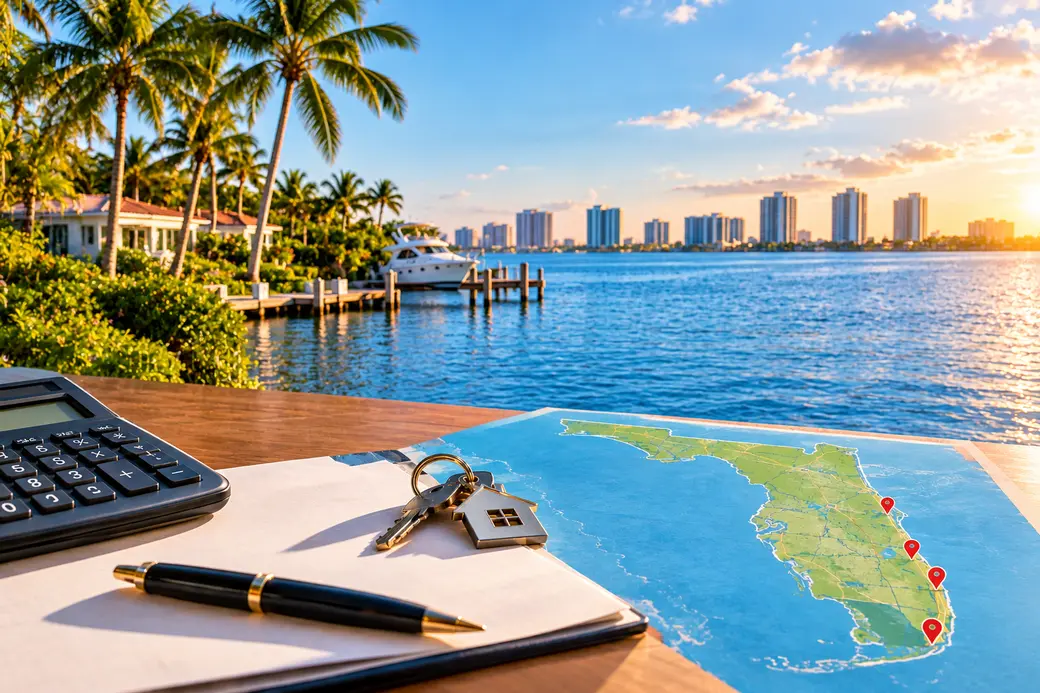
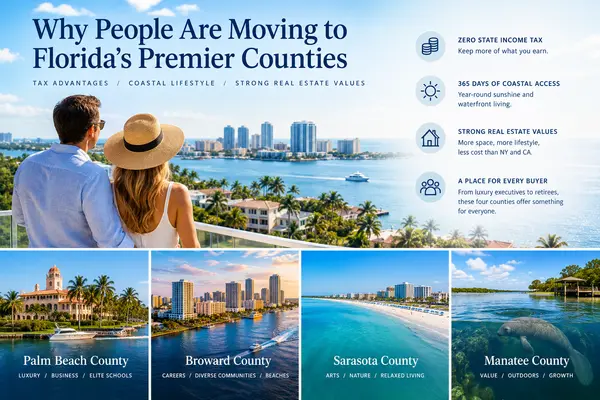
Florida has no state income tax, saving a household earning $300,000 annually roughly $15,000–$35,000 compared to New York, California, or New Jersey. Add no estate tax, no inheritance tax, and property tax rates that typically run below what Northeast and Midwest buyers are used to, and the financial case for relocating is real. Which of Florida's four main destination counties fits your budget, lifestyle, and origin state is what this guide works out, covering Palm Beach, Broward, Sarasota, and Manatee across luxury, mid-range, and affordable tiers.
Florida's Tax Advantage: What the Numbers Actually Show
Florida's zero state income tax is the headline, and it is genuinely significant. New York's state income tax runs from 4% to 10.9%, plus a New York City surcharge of up to 3.876% for city residents. California's top rate is 13.3%. Illinois sits at a flat 4.95%. New Jersey reaches 10.75% at the upper brackets, per Tax Foundation state income tax rate data. The moment you establish Florida domicile, that entire state income tax obligation drops to zero.
For context: for a single filer earning $500,000 in New York City, combined NY state and city income tax approaches roughly $55,000–$58,000 per year, dropping to zero with Florida domicile. (For married filing jointly the combined figure is lower; confirm with your CPA for your specific filing status.)
Florida also levies no state estate tax, no inheritance tax, and no gift tax. For families considering generational wealth transfer, particularly those leaving Massachusetts (state estate tax kicks in above $2 million) or New York (above $7.16 million), eliminating state-level estate exposure is a meaningful planning advantage. Multi-state financial planning practitioners generally advise establishing Florida domicile well in advance of any anticipated estate events.
One important caveat: Florida's property insurance costs and property tax structure do claw some of that savings back, and the degree depends significantly on your county and price tier.
Property Taxes Across Florida's Four Counties: What Buyers Actually Pay
Florida's homestead exemption reduces a primary residence's taxable value by up to $50,000. The Save Our Homes cap then limits annual assessed-value increases to 3% or the CPI change, whichever is lower, 2.9% for the 2025 tax year per the Pinellas County Property Appraiser's published CPI table. That cap makes long-term ownership cost-predictable in a way that Northeast property owners rarely experience. Portability lets you carry accumulated tax savings to a new Florida home when you move within the state.
What you pay in year one, before the cap builds, depends on your county's millage rate:
| County | 2025 Combined Millage (approx.) | Effective Rate on Homesteaded Property |
|---|---|---|
| Palm Beach | ~18.72 mills | ~0.83–1.73% depending on municipality |
| Broward | ~17.7–21.6 mills depending on city | ~1.0–1.4% |
| Sarasota | County average | ~1.2% homesteaded; ~1.4% non-homesteaded |
| Manatee | ~17.29 mills | ~1.2–1.53% |
(Source: Broward County Property Appraiser 2025 adopted millage table; Palm Beach County 2025 millage data; Sarasota and Manatee County property appraiser offices. Rates vary by city and special taxing district, verify your specific parcel before purchase.)
Compare that to where most relocators are leaving. New Jersey's effective property tax rate is 1.88% on owner-occupied housing, the highest in the nation, per Tax Foundation 2024 data. Illinois comes in at 1.88% as well. Connecticut sits at 1.54%. New York State's effective rate averages 1.30% statewide, though Westchester and Long Island communities frequently run well above 2% at the local level. Even at Florida's higher end, most homesteaded properties carry a meaningfully lower effective rate than comparable Northeast markets.
For buyers beginning their search, the Florida relocation guide covering Palm Beach, Broward, Sarasota, and Manatee includes community profiles and buyer timelines alongside the county-by-county financial breakdown.
Four Counties × Three Price Tiers: Quick Reference
Here is how the four markets compare across price tiers, all figures reflect aggregated MLS listing and sale data (twelve months ending December 2025), sourced from BeachesMLS for Broward and Palm Beach, and RASM-provided MLS data for Sarasota and Manatee:
| County | Luxury Tier | Mid-Range Tier | Affordable Tier |
|---|---|---|---|
| Palm Beach | $2M–$15M+ | $600K–$1.2M | $300K–$450K |
| Broward | $2M–$6M | $550K–$900K | $250K–$400K |
| Sarasota | $2M–$8M+ | $450K–$900K | $300K–$475K |
| Manatee | $1.5M–$5M+ | $400K–$750K | Under $375K |
Palm Beach County: Florida's Luxury Benchmark
Palm Beach County holds the most concentrated high-end real estate market in Florida. The county's single-family home median sale price reached $643,000 in October 2025, up 3.46% year-over-year, according to MIAMI Realtors data sourced from BeachesMLS. The town of Palm Beach itself operates at a different level, Q4 2025 single-family sales averaged around $15 million.
Luxury tier: Waterfront estates in Palm Beach, Gulf Stream, and Manalapan regularly trade above $5 million, with oceanfront and Intracoastal properties commanding premiums for deep-water dockage, private boat lifts, and impact-resistant construction. CBS (concrete block) framing with impact glass throughout is now standard at this price point and carries meaningful wind mitigation credits that reduce insurance costs relative to older wood-frame equivalents.
For buyers from Manhattan, Greenwich, or Beverly Hills, a $3 million budget in Palm Beach can secure gated privacy and direct water access at terms impossible to replicate in the Northeast. Private school options, including Palm Beach Day Academy and The Benjamin School, provide educational infrastructure on par with top Northeast prep markets, and proximity to Palm Beach International Airport makes private or commercial air travel convenient. For buyers at this level, policies written on an agreed-value basis (rather than replacement-cost ACV) are standard practice and worth requesting specifically; they eliminate the depreciation disputes that arise after storm events.
Mid-range: Boca Raton, Boynton Beach, and Wellington offer strong school districts, newer construction, and single-family homes in the $600,000–$1.2 million range, directly competitive with suburban Westchester or Nassau County inventory, without New York income tax and with a lower property tax bill. Wellington's equestrian community is an additional draw for buyers from Connecticut and New Jersey horse country.
Affordable tier: The northern reaches of the county, Lake Worth Beach, Greenacres, and Belle Glade, bring entry-level pricing into the $300,000–$450,000 range. Buyers at this tier should budget carefully for insurance costs and confirm flood zone designation before making an offer; carrying costs can represent a larger proportion of the monthly payment at lower price points than at higher ones.
Broward County: South Florida Value with Urban Energy
Broward County, home to Fort Lauderdale, Hollywood, Pembroke Pines, and Coral Springs, is the mid-market alternative to Palm Beach County and Miami-Dade, offering South Florida's lifestyle at a generally lower average price. Monthly single-family medians ranged from approximately $611,000 to $640,000 across 2025, per MIAMI Realtors monthly reports sourced from BeachesMLS.
Luxury tier: Las Olas Isles, Harbor Beach, and the Coral Ridge waterfront neighborhoods offer deep-water dockage with ocean access via the New River and Port Everglades inlets, and estate-sized lots in the $2–6 million range. Las Olas Isles lots specifically are surveyed for draft depth, buyers with larger vessels (above a 4-foot draft) should verify clearance before committing to a specific address. CBS construction with impact glass is the benchmark for insurable luxury product in Broward; older wood-frame or tile-roof properties in this range warrant a full wind mitigation inspection before any offer. Fort Lauderdale is increasingly attracting buyers who want boating culture, walkable neighborhoods, and proximity to Fort Lauderdale–Hollywood International Airport without Palm Beach's price premium.
Mid-range: Weston, Plantation, and Coral Springs consistently deliver family-friendly master-planned living, top-rated schools, low crime, and established amenities, in the $550,000–$900,000 band. These communities are popular landing spots for families relocating from New Jersey and New York, where comparable school districts and suburban infrastructure carry significantly higher housing and property tax costs.
Affordable tier: Lauderhill, Margate, and North Lauderdale offer condos and townhomes generally in the $250,000–$400,000 range. Broward combined millage in some municipalities reaches 21+ mills, per the Broward County Property Appraiser's 2025 adopted millage table; calculate the tax on your specific parcel before committing.
Sarasota County: Gulf Coast Lifestyle with a Cultural Core
Sarasota County is the Gulf Coast destination for relocators who want beach quality, arts infrastructure, and a slower pace without South Florida's density. The REALTOR® Association of Sarasota and Manatee (RASM) reported full-year 2025 single-family median sale prices at $474,700 for Sarasota County, down 6% from 2024, reflecting a buyer-friendly correction, with an average sale price of $682,999.
Luxury tier: Casey Key, Bird Key, and Siesta Key waterfront properties command $2–8 million and above. Casey Key lots frequently exceed half an acre and offer deep-water bay-side access that supports private docks, a meaningful premium driver for serious boaters. Bird Key sits between downtown Sarasota and St. Armands Circle and is known for direct Sarasota Bay access, with many properties featuring slips capable of accommodating vessels in the 35–50-foot range. For buyers relocating from Chicago's North Shore, Sarasota's cultural calendar, opera, ballet, theatre, and visual arts at world-class facilities, is a genuine lifestyle match, and Out-of-Door Academy provides private K–12 education comparable to what North Shore families expect. At the luxury tier, agreed-value insurance coverage and a pre-purchase wind mitigation inspection are worth prioritizing before closing on any older barrier island property.
Mid-range: Lakewood Ranch, Palmer Ranch, and the Sarasota city corridor offer single-family homes in the $450,000–$900,000 range, well-suited to families and remote workers relocating from the Midwest or Northeast. Chicago is the top origin metro for the North Port–Sarasota–Bradenton MSA, per data cited by RASM. Lakewood Ranch consistently ranks among the top-selling master-planned developments in the U.S. and offers A-rated schools, extensive recreational amenities, and well-developed commercial infrastructure.
Affordable tier: North Port and Venice offer entry-level single-family homes in the $300,000–$475,000 range, often with newer construction and community amenities. Buyers at this tier should confirm flood zone designation and request a wind mitigation inspection, newer construction in non-flood-zone locations can qualify for significantly lower premiums, making these among the most accessible Gulf Coast options for first-time Florida buyers and retirees on fixed income.
Current inventory across Sarasota County's price tiers, including Sarasota County homes and Gulf Coast listings, reflects the post-2024 correction and is worth reviewing early in the research process.
Manatee County: The Emerging Gulf Coast Market
Manatee County, encompassing Bradenton, the Manatee side of Lakewood Ranch, Anna Maria Island, and Longboat Key's northern tip, offers pricing slightly more accessible than neighboring Sarasota County. RASM's full-year 2025 data put the Manatee single-family median at $475,000 (down 5% year-over-year), with average sale prices around $635,000.
Luxury tier: Anna Maria Island and Longboat Key's northern Manatee side offer some of the Gulf's most coveted beachfront real estate, with luxury homes ranging from $1.5 million into the $5 million-plus range. The experience is boutique, low-density, and intensely natural. On Anna Maria Island specifically, buyers should confirm FEMA flood zone classification and Base Flood Elevation compliance for any property, homes built to BFE+2 or BFE+3 with pilings and impact glass typically qualify for meaningfully lower flood insurance rates under FEMA's Risk Rating 2.0 framework. CBS construction is the preferred structural choice for insurability in this coastal zone. The Longboat Key Club on the island's southern end provides resort amenities, golf, marina, dining, accessible to some northern-end Manatee buyers.
Mid-range: Lakewood Ranch (Manatee side), Parrish, and Ellenton provide growing family-oriented communities with newer construction in the $400,000–$750,000 range. Bradenton's waterfront corridor is seeing active investment in mixed-use and residential development, with growing dining, arts, and entertainment infrastructure drawing comparisons to Sarasota's downtown trajectory a decade ago.
Affordable tier: Eastern Bradenton, Palmetto, and Parrish's outlying areas bring entry-level pricing under $375,000. Palmetto sits roughly 10 miles from central Bradenton and 45 miles from Sarasota by highway, making it accessible for buyers who need Gulf Coast affordability and are willing to commute to larger employment centers. Newer construction in non-coastal Parrish can qualify for lower insurance tiers, making total carrying costs genuinely competitive for buyers relocating from higher-cost Midwest or Northeast markets.
For buyers comparing options across both Gulf Coast counties, the Sarasota and Manatee County buyer overview covers community profiles and current market conditions side by side.
The Cost You Must Budget For: Florida Property Insurance
Florida homeowners' premiums rose approximately 75% between 2021 and 2025, according to reports by the Miami Herald. Citizens Insurance, the state-backed insurer of last resort, implemented rate increases of up to 14% for primary residences for policies renewing from January 2025. What you pay depends heavily on the specific address: proximity to coast, roof age, construction type, flood zone designation, elevation, and wind mitigation features.
| Buyer Tier | Typical Combined Annual Premium | Key Variables |
|---|---|---|
| Luxury (coastal / $2M+) | $12,000–$20,000+ | Flood zone, replacement cost, roof profile, agreed-value vs. ACV policy |
| Mid-range (inland master-planned) | $4,000–$8,000 | Wind mitigation credits, construction type, roof age |
| Affordable (non-coastal, non-flood-zone) | Under $3,500 | Newer construction discounts, wind mitigation inspection credits |
The practical guidance for all three tiers: obtain actual insurance quotes for any specific property before making an offer. Do not use statewide averages to estimate your policy. A wind mitigation inspection is worth commissioning before you close, it is one of the highest-return pre-purchase steps available in Florida.
What Daily Life in Florida's Four Counties Actually Looks Like
Year-round outdoor access, meaningfully lower taxes, and a climate shift are the three changes relocators consistently describe as most significant. Beyond those, a few adjustments are worth preparing for:
-
Year-round outdoor access. Beach parking in Sarasota and Manatee is typically free or low-cost. Boating is a realistic daily option for many Gulf Coast homeowners, not a seasonal activity, but the baseline.
-
Winters are genuinely different. January and February in Palm Beach County are peak season. On the Gulf Coast, the desirable window runs October through April. The psychological shift from Northeast winters is consistently cited as one of the most significant quality-of-life improvements relocators report.
-
Summer heat and humidity require honest budgeting. June through September is hot, humid, and the core of hurricane season. Florida power bills in summer typically run higher than utility costs in northern states during their mild months, build this into your monthly carrying cost comparison.
-
Establishing domicile requires follow-through. High-tax states, especially New York, California, Massachusetts, and New Jersey, audit former residents aggressively. Spending more than 183 days per year in Florida is necessary but not sufficient. Auditors examine where your key possessions are located, where your primary doctors and financial relationships are based, and where you celebrate important events.
File a Declaration of Domicile, obtain a Florida driver's license and vehicle registration, and register to vote in Florida. Then genuinely transfer the center of your personal and financial life here. Work with a multi-state CPA from the start.
FAQ
-
How do Florida property taxes compare to New York and New Jersey?
Florida's effective property tax rate with homestead exemption typically falls between 0.83% and 1.4% depending on county and city. New Jersey's effective rate is 1.88% on owner-occupied housing, the nation's highest, per Tax Foundation 2024 data. New York's statewide effective rate averages 1.30%, though Westchester and Nassau County communities frequently run well above 2% at the local level. For a homesteaded $650,000 home in Palm Beach County, annual taxes run roughly $8,000–$10,000. A comparable-priced property in Bergen County, New Jersey, could run $10,000–$14,000 annually depending on the municipality.
-
Is Palm Beach County more expensive than Sarasota County?
By median sale price, yes. Palm Beach County's single-family median was approximately $643,000 in October 2025, while Sarasota County's full-year 2025 median came in at $474,700, per RASM data. Both counties have luxury tiers that extend well above their medians. Sarasota and Manatee are generally more accessible for mid-range and affordable buyers, while Palm Beach County offers deeper inventory at the high end and ultra-luxury range.
-
Do I need to worry about Florida domicile audits when I move from New York?
Yes, particularly if you are leaving New York with a meaningful state income tax obligation. New York's tax authority audits aggressively and looks well beyond the number of days spent in the state. Auditors examine domicile factors including where your nearest and dearest possessions are kept, where your primary doctors and financial relationships are based, and where you celebrate important events. The 183-day physical presence threshold is necessary but not sufficient on its own. Work with a multi-state CPA before, during, and after your move. For families also navigating estate planning, note that New York imposes a state estate tax above $7.16 million and Massachusetts above $2 million, per Tax Foundation estate and inheritance tax data, Florida has neither.
-
Which Florida county is best for families relocating from the Midwest?
Sarasota and Manatee counties are consistently the top destinations for Midwest relocators, particularly from Chicago, Columbus, and Detroit. Lakewood Ranch straddles both counties and is one of the top-selling master-planned communities in the U.S., with A-rated schools, extensive recreational amenities, and well-developed commercial infrastructure. Price points in the $400,000–$700,000 range make it directly competitive with upper-Midwest suburbs, with a dramatically better climate and zero state income tax.
-
How much should I budget for homeowners insurance in South Florida?
There is no single accurate number. Coastal Palm Beach and Broward properties with wind and flood exposure, particularly luxury homes above $2 million, can see combined premiums from $12,000 to $20,000+ annually. Mid-range inland properties in communities like Weston or Boca Raton typically fall in the $4,000–$8,000 range. Affordable-tier buyers in non-flood-zone communities may qualify for coverage under $3,500 with wind mitigation credits and newer construction discounts. Get quotes for the specific address before making any purchase decision, and commission a wind mitigation inspection before closing.
Categories
Recent Posts

Leave a reply